

Buyer guide
How to check mileage by VIN and spot odometer rollback
Where recorded odometer readings come from, how to read a mileage timeline, what odometer brands mean and which signs suggest a rolled-back odometer.
Start here
Enter the VIN
Free VIN check. No payment card needed.
The number on the dashboard is only the latest claim about a car's mileage. A VIN mileage check compares it with the readings recorded for the same VIN over the years. A reading that goes down, or a timeline that does not add up, is a reason to ask questions before you pay.
This guide covers vehicles built for the US market, including cars bought at US auctions for export. Every reading in a report comes from a source that recorded it, so a report can show only what its sources received; records vary by VIN.
Where recorded mileage comes from
Odometer readings are written down by different people at different times. A history report brings together the readings that reached its sources:
Title transfers
When a vehicle changes owner in the US, the seller usually has to state the odometer reading in writing, and the state keeps it with the title record.
Inspections and registration
Some states record the odometer at safety or emissions inspections or when a registration is renewed.
Sales and auctions
Dealer listings and auction lots usually show the mileage at the time of sale, with the date.
Service and repairs
Workshops often write the mileage on invoices. Some service records reach history databases; many stay only with the owner.
Each reading is what someone recorded on a given date. A report repeats it; it does not measure the car.
How to read a mileage timeline
-
Sort the readings by date
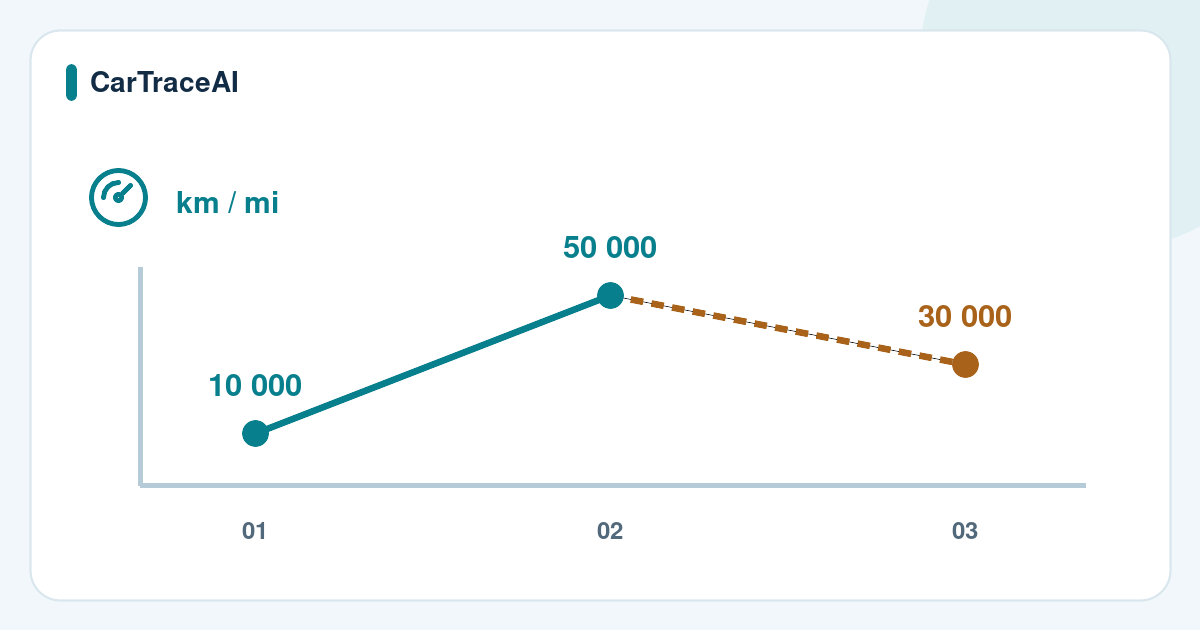
Use every reading you have: the report, the title, the lot page and any invoices. Mileage only goes up, so no reading should be lower than an earlier one.
-
Check miles and kilometres
US records are in miles. The same distance in kilometres is a larger number: one mile is about 1.609 kilometres. Convert before you compare.
-
Work out miles per year
Divide the miles between two readings by the years between them. Compare the result with how the seller describes the car's use and with its condition.
-
Ask about the gaps
Years without a reading are common and prove nothing on their own. Ask for service invoices or inspection records that cover them.
Odometer brands and what they mean
Unless the vehicle is exempt, a seller in the US certifies at each change of ownership that the reading is the actual mileage, that it exceeds the odometer's mechanical limits, or that it is not the actual mileage and should not be relied upon. The result can appear on the title as an odometer brand and on an auction lot page as the odometer status.
Actual
To the best of the seller's knowledge, the reading is the true mileage. It is a statement, not a check.
Not actual mileage
The reading is known not to be the true mileage, for example because the odometer was altered, broken or replaced. Do not rely on it.
Exceeds mechanical limits
The vehicle has travelled more than the odometer can display, so the true mileage is higher than the number shown.
Exempt
No written mileage disclosure was required for the transfer. This does not confirm that the displayed mileage is correct.
Under federal rules, vehicles of model year 2010 and older are exempt from mileage disclosure; for model year 2011 and newer, the exemption begins 20 years after the model year. Vehicles with a gross vehicle weight rating over 7,257 kg (16,000 lb) are exempt too.
Warning signs of odometer rollback
Rolling back an odometer makes a car look less used than it is. An odometer rollback check compares the recorded readings with the documents and the car itself. Look for:
- A reading lower than an earlier one for the same VIN, even after allowing for miles and kilometres.
- Service invoices, inspection records or oil-change stickers that show more miles than the dashboard.
- Mileage on the title that is hard to read, corrected or looks altered.
- Wear on the pedals, steering wheel, driver's seat or gear lever that looks heavy for the mileage shown.
- On a mechanical odometer, digits that are misaligned, have gaps or turn unevenly.
- A notice on the left door frame about an odometer repair or replacement: add the mileage written on it to the current reading.
Digital odometers can be altered too, and a changed number looks normal on the display. One sign alone proves nothing; several together are a reason to investigate before you pay.
What the ClearVin report can show about mileage
The report described on our pricing page is the original ClearVin PDF, based on US sources including NMVTIS. When records exist for the VIN, its mileage information can include:
Odometer readings by date
Each reading with its date and the source that reported it, such as a state motor vehicle department, NMVTIS or a dealer.
Average miles per year
A chart of the average miles driven per year between readings, so that an unusual change stands out.
Title history and brands
The mileage recorded with each title and any odometer brand reported to NMVTIS, such as not actual mileage.
Owners and past sales
The last reading for each recorded owner and the mileage in past sale listings, with photos where available.
Records vary by VIN. A report without a mileage warning shows what its sources returned; it does not certify the reading on the dashboard.
US federal odometer law in brief
Federal law (49 U.S.C. chapter 327) prohibits disconnecting, resetting or altering an odometer to change the mileage it registers, and selling or installing devices that make it show a different mileage. Violations can lead to civil and criminal penalties, and a buyer can sue anyone who broke these rules with intent to defraud.
When ownership changes, the seller must give the buyer a written disclosure of the mileage. The National Highway Traffic Safety Administration (NHTSA) sets the details in 49 CFR Part 580, including which vehicles are exempt.
An odometer may be repaired or replaced. If the reading cannot stay the same, the odometer must be set to zero and a notice with the earlier mileage and the date attached to the left door frame.
After export: miles, kilometres and missing years
A US history report ends where the US records end. After export, readings are taken in other countries, usually in kilometres, and they normally do not appear in US records.
- Convert the last US reading to kilometres (miles × 1.609) before you compare it with the dashboard.
- Ask the seller or importer for export, import and registration documents and any mileage recorded in them.
- If the instrument cluster was replaced or switched from miles to kilometres, ask for the reading before the change and the workshop invoice.
- Have the car inspected where it is, and check that its wear matches the claimed mileage.
On CarTraceAI
The free VIN check decodes the manufacturer's data for the VIN. If ClearVin has data, it also shows a photo and the number of auction and damage records. The free check is not a history report and does not show odometer readings; recorded readings, when available, are in the paid report. Check the pricing page for current coverage and ordering availability for your VIN before paying.
Before you check
Frequently asked questions
Can I check a car's mileage by VIN for free?
Not on CarTraceAI. The free VIN check decodes the manufacturer's data and does not search odometer records. Recorded readings, when available, are in the paid history report.
Does the VIN contain the mileage?
No. The VIN identifies the vehicle. Odometer readings are recorded separately, with their dates, and looked up by VIN.
Can a report prove the odometer was never rolled back?
No. It shows the readings its sources received. A rollback between two recorded readings, or before the first one, may not be visible, so check the documents and the car as well.
What does "not actual mileage" mean?
The odometer reading is known not to be the true mileage and should not be relied upon. The true mileage may be unknown.
Why would a later reading be lower than an earlier one?
Possible reasons include a typing error, miles and kilometres mixed up, an older odometer that passed its maximum and restarted from zero, or a replaced odometer set to zero, which must be noted on the door frame. If none of these explains it, treat it as a possible rollback.
Sources and further reading
- US Code, 49 U.S.C. chapter 327: odometer tampering, repairs and mileage disclosure
- NHTSA rules, 49 CFR Part 580: odometer disclosure requirements and exemptions
- US Department of Justice: what NMVTIS shows, including the latest odometer reading
- US Department of Justice: why odometer readings matter in an NMVTIS report
- FTC: buying a used car and arranging an independent inspection